

Bosch’s cloud-based road hazard service has been live in BMW Group passenger vehicles since March 2026, with deployment now spanning the BMW iX1, iX2, iX3, X3, and several Mini models. The Stuttgart-based supplier said it plans to expand the service to additional BMW vehicles over the next few years. The system pulls continuously updated data from connected vehicle fleets and third-party sources to warn drivers of conditions such as black ice, sudden fog, and accidents ahead. Bosch outlined the BMW Group rollout in a statement issued from Stuttgart and Munich.
Highlights
- March 2026 BMW launch: Service now active in BMW iX1, iX2, iX3, X3, and several Mini models, with phased expansion planned.
- Scale: Bosch says the service is operating in millions of cars and commercial vehicles across Europe and the United States since its June 2024 debut.
- Wrong-way driver warning: Bosch claims sole-provider status on a cloud-based wrong-way driver alert, available bundled or as a standalone feature.
- ADAS integration: Predictive warnings can feed adaptive cruise control and emergency braking assist for earlier system response.
How the Service Works
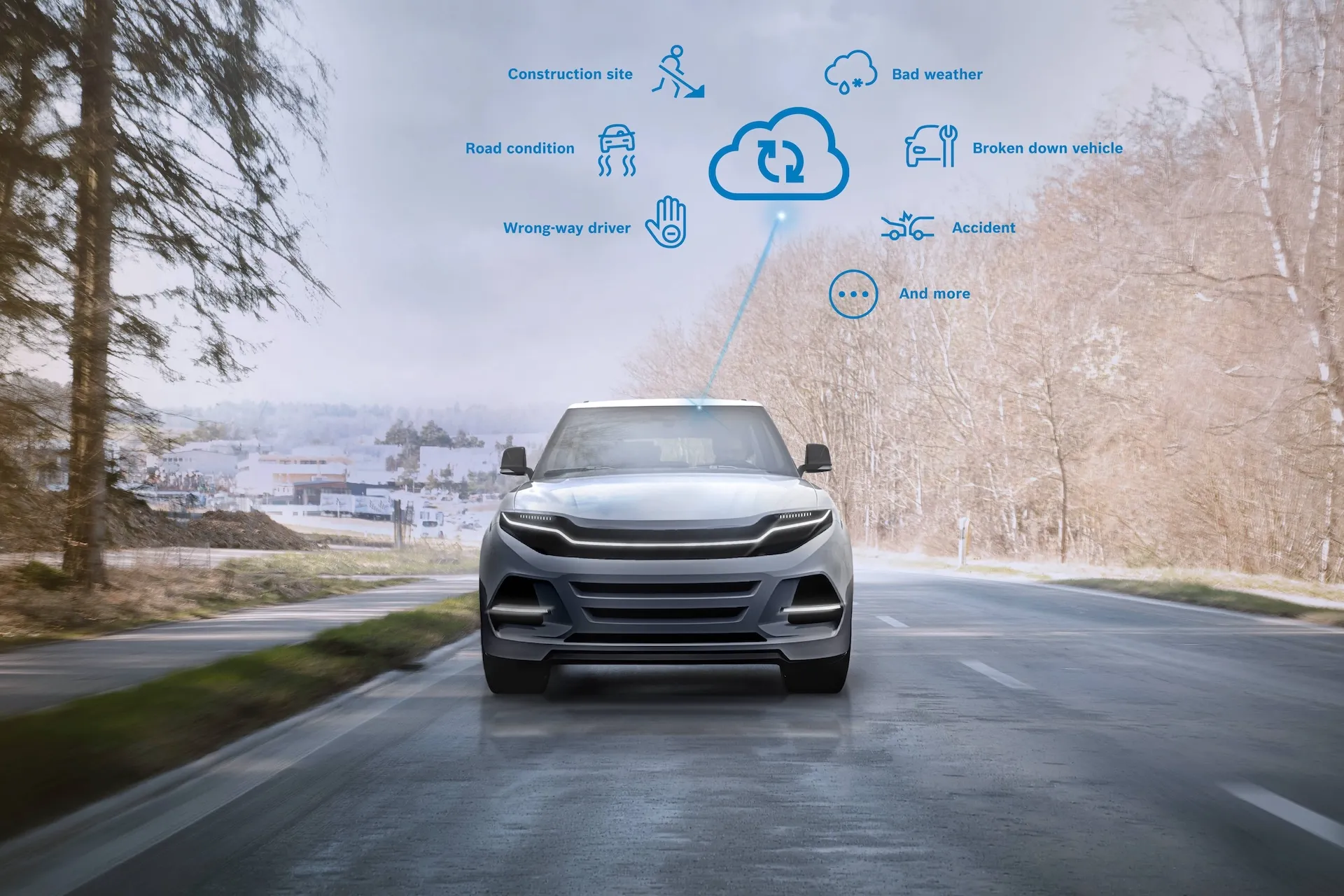
The road hazard service combines anonymized real-time telemetry from a global fleet of connected vehicles with feeds from weather services and road operators. An algorithm continuously analyzes vehicle inputs such as electronic stability program (DSC) interventions and windshield wiper activity. When the system detects, for example, many vehicles in a region operating wipers at the highest setting alongside heavy-rain weather data, it flags hydroplaning risk and pushes warnings to drivers in the affected area.
Bosch validates output through a dedicated test fleet equipped with specialized sensors, and external sources including roadside webcams cross-check warnings before they are issued. Vehicle manufacturers can configure the trigger sensitivity to match their own warning philosophy — a calibration option Bosch positions as a differentiator from competing connected-safety services.
The service covers accidents, abandoned vehicles in construction zones, heavy rain, snow, and high winds. Driver assistance functions including adaptive cruise control and emergency braking assist can use the predictive layer to react earlier than they would on onboard sensor data alone.
Wrong-Way Driver Warning
Bosch’s wrong-way driver alert sits inside the broader road hazard package or can be licensed independently. A European high-volume manufacturer Bosch did not name has integrated the feature. The warning surfaces either in the in-vehicle cockpit display or on a smartphone, and Bosch said partner apps carrying the function have been downloaded more than 100 million times collectively.
The technology is designed to flag wrong-way drivers seconds before they are visually detectable to oncoming traffic, giving drivers time to slow or change lanes. A separate connected speed limit feature, which surfaces dynamic limits tied to construction zones, wet roads, or time of day, was previewed as part of the same product family.
Industry Context
The BMW Group deployment lands as Tier 1 suppliers expand cloud-based safety services beyond fleet-management use cases into mainstream consumer vehicle platforms. Bosch’s first OEM customer for the service was a European passenger car manufacturer in June 2024, followed by a commercial vehicle maker six months later. The progression — passenger cars, then heavy trucks, then a premium OEM at scale — tracks with the broader pattern of cloud-fed ADAS features migrating from commercial logistics fleets, where uptime and safety incentives drive earlier adoption, into retail vehicle programs.
Bosch’s approach pairs this connected layer with its in-vehicle sensor portfolio. The supplier recently introduced seventh-generation ultrasonic chipsets designed to feed raw sensor data to AI-based ADAS systems, alongside a radar sensor with an in-house system-on-chip and a refreshed ADAS product family. The road hazard service sits above that hardware stack, providing an off-vehicle data source that complements rather than replaces onboard perception.
For BMW, the Bosch tie-up adds a third-party data layer on top of the automaker’s own connected-vehicle history, which extends back to its Hazard Preview functionality launched in 2016.
Executive Comment
“The road hazard service from Bosch increases road safety while also increasing the ease of driving. Our cloud-based service is a tangible win for our customers because it predicts and informs drivers, whether they are in a car or a truck, of hazards on the route and helps them avoid critical situations,”
said Dr. Markus Heyn, member of the Bosch board of management and chairman of the Mobility business sector.
Sign up for our weekly emails to stay up to date on the latest news!