

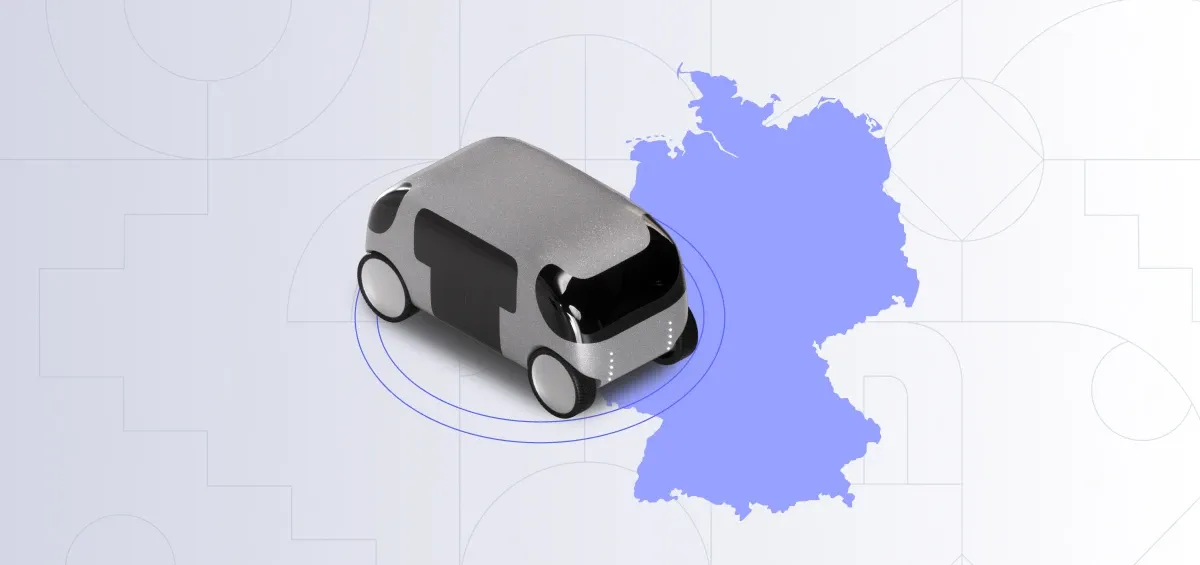
Vehicles equipped with Mobileye Drive account for more than 60 percent of all vehicles holding valid SAE Level 4 testing permits in Germany, according to Mobileye’s evaluation of data from the Kraftfahrt-Bundesamt (KBA), the country’s Federal Motor Transport Authority. The company says those vehicles span three distinct platforms rather than a single specialized model, a point it uses to argue that Mobileye Drive can be integrated across different vehicle architectures and mobility programs.
Highlights
- More than 60 percent of vehicles with valid Level 4 testing permits in Germany use Mobileye Drive, per the company’s reading of KBA data.
- Three vehicle platforms are represented among the permitted Mobileye Drive vehicles.
- Three service models are in operation in Germany: urban ride-pooling, scheduled shuttle routes, and regional on-demand public transit.
What Does a Level 4 Testing Permit Mean?
Germany operates a structured permitting process for automated vehicles on public roads, and the KBA publishes a snapshot of Level 4 testing activity through its list of granted testing approvals.
As Mobileye describes it, a Level 4 automated driving system performs the complete dynamic driving task within a defined Operational Design Domain (ODD) without requiring a human driver to take control. Within that domain, the system must handle mixed urban traffic, complex intersections, and pedestrian behavior.
How Mobileye Drive Is Built for Driverless Service
Mobileye positions Drive as a commercial L4 self-driving system, including the software and hardware stack, for autonomous mobility-as-a-service. Target applications include high-occupancy ride-pooling, fixed-route urban shuttles, and on-demand public transit.
Rather than tying operators to one vehicle model, the company says the system is intended to let vehicle manufacturers and transit providers commercialize driverless fleets. The stack combines several Mobileye technologies:
- Physical AI: AI-driven perception and decision-making to interpret surroundings and support driving decisions.
- REM: Road intelligence data.
- EyeQ: The company’s compute platform.
- Redundancy and safety frameworks: Sensor redundancy paired with formal safety frameworks.
Mobileye also says it supplies interface tools, software integration, and operational expertise to connect vehicle manufacturers, mobility operators, municipal transit authorities, and city infrastructure.
One System Across Multiple Vehicle Formats
According to Mobileye, each German deployment model brings different routing profiles, passenger interaction patterns, and speed requirements. Vehicle integration varies as well: an electric shuttle built for dense city centers requires different mechanical integration than a passenger car adapted for suburban ride-pooling.
The company argues that running across multiple programs exposes the system to a wider range of road structures, traffic patterns, weather conditions, and operating environments. Mobileye says this matters for a system designed to generalize across ODDs on a common foundation of driving intelligence and safety.
Mobileye says it plans to expand its Level 4 collaborations as regulatory frameworks develop in Germany and other markets.