
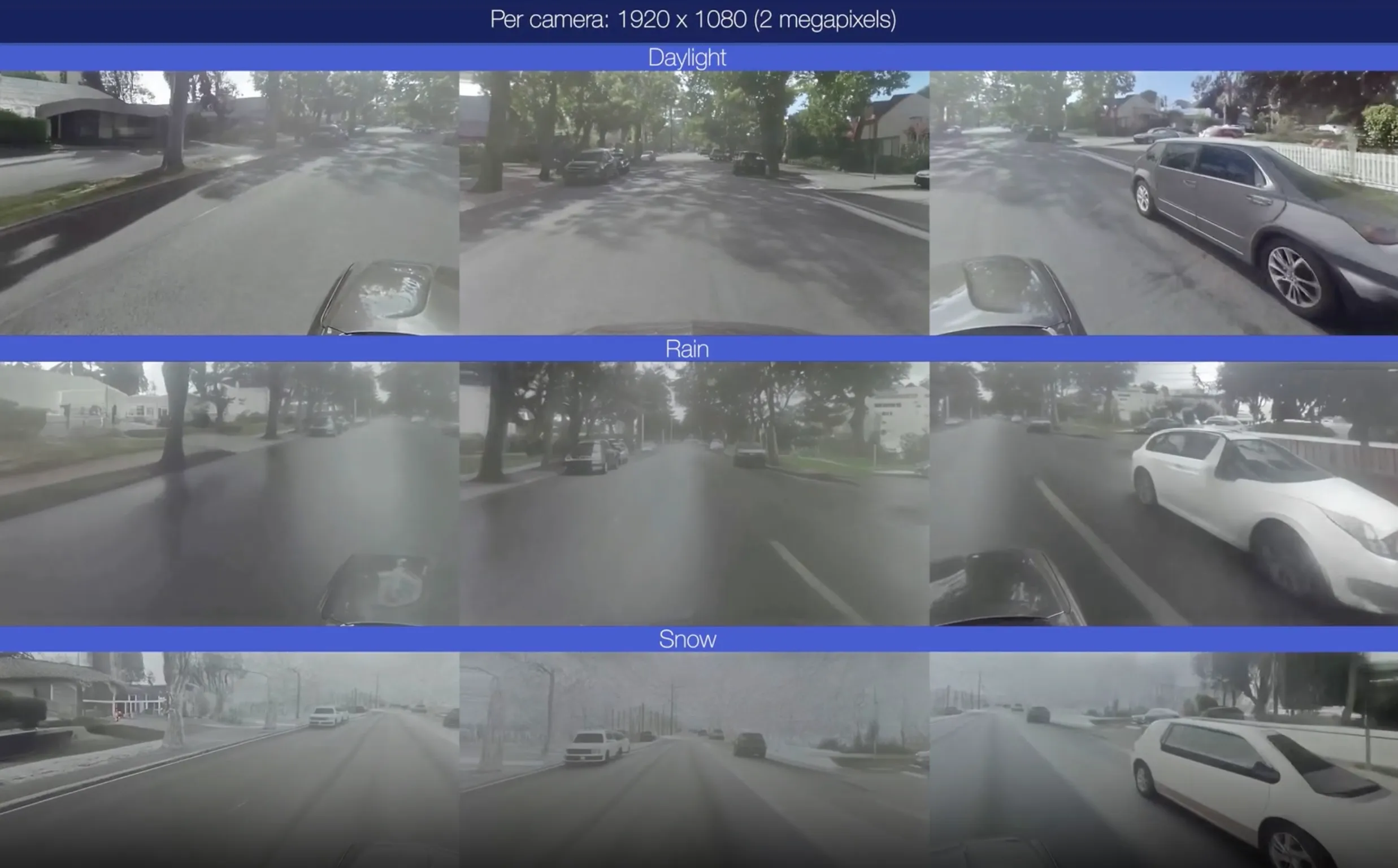
Helm.ai has launched two generative AI models, GenSim-3 and VidGen-3, that render synthetic camera data at native Full HD (1920×1080) resolution across a six-camera, 360-degree surround-view suite — a 12-megapixel synchronized canvas per timestep. The autonomous driving software developer, which builds perception and simulation tools for ADAS and Level 4 systems, says the output reaches five times the pixel density of current generative world-model benchmarks. Helm.ai positions the new foundation models as a production-ready answer to rising real-world data-collection costs.
Highlights
- GenSim-3 and VidGen-3 render native Full HD (2MP) per camera across a 6-camera surround view, producing a 12-megapixel synchronized canvas per timestep.
- Helm.ai reports five times the pixel density of standard generative world models, which typically operate at sub-HD or VGA-level resolution near 0.4 megapixels per camera.
- Configurable architecture supports 3-camera setups at 30 fps for high-speed validation or a full 6-camera, 12-megapixel surround view at 5 fps.
- The company says it reached the Full HD milestone using a few hundred advanced GPUs rather than the thousands typical of comparable models.
Matching Production Sensor Resolution
The central claim behind both models is resolution parity with vehicle hardware. Helm.ai reports that standard generative world models run at roughly 0.4 megapixels per camera, while production vehicles increasingly carry high-resolution sensors. The company argues that training a Full HD perception stack on sub-HD synthetic data opens a domain gap, and that generating natively at 2MP per camera lets neural networks train on the same pixel density they process on the road.
The architecture is configurable for different sensor and training needs. Engineering teams can run 3-camera setups at 30 frames per second for dynamic, high-speed validation, or use the full 6-camera, 12-megapixel surround view at 5 fps to maximize spatial context.
How Does the Model Emulate Real Sensor Behavior?
Helm.ai describes its models as hardware-accurate virtual sensors that reproduce specific physical constraints rather than generating clean CGI-style video. According to the company, the models deliberately reproduce hardware sensor anomalies including native sensor banding, optical lens flares, and dynamic exposure blinding. The stated goal is to give perception stacks inputs that mirror real-world sensor behavior for more robust training.
Two Models: Scene Transfer and Fully Synthetic Generation
The platform splits across two functions for data augmentation and creation:
- GenSim-3 handles high-fidelity scene transfer, restyling real-world video synchronously across the 6-camera surround view. The model adjusts weather, illumination, and object appearance at Full HD resolution, and the company reports improvements in environmental texture, surface reflectivity, and light behavior on complex materials.
- VidGen-3 generates driving sequences fully synthetically, simulating environments, human-like agent behaviors, and traffic logic from scratch to address geographic and environmental data gaps.
A Lower Compute Footprint
Helm.ai reports reaching the Full HD milestone with a cluster of a few hundred advanced GPUs, in contrast to the thousands of GPUs it says other generative world models use to produce sub-HD video. The company states that its generative architecture also supports compressing autonomous driving software onto lower-cost, mass-market vehicle compute chips.
Helm.ai founder and CEO Vladislav Voroninski tied the release to the limits of conventional AI video. “We are moving the industry from standard ‘AI video’ to authentic, hardware-accurate sensor emulation,” he said. “By leading with a Full HD (2MP) standard and a 12-megapixel total aggregate capability per timestep, we have solved the resolution bottleneck that has historically limited the utility of generative AI in safety-critical systems. By optimizing our compute architecture, we are giving our partners a high-performance platform to validate their autonomous stacks using synthetic data that perfectly matches the fidelity of their actual production sensors.”
Founded in 2016, Helm.ai develops full-stack AI software for on-vehicle deployment and simulation, and partners with global automakers on production programs.
Sign up for our weekly emails to stay up to date on the latest news!