
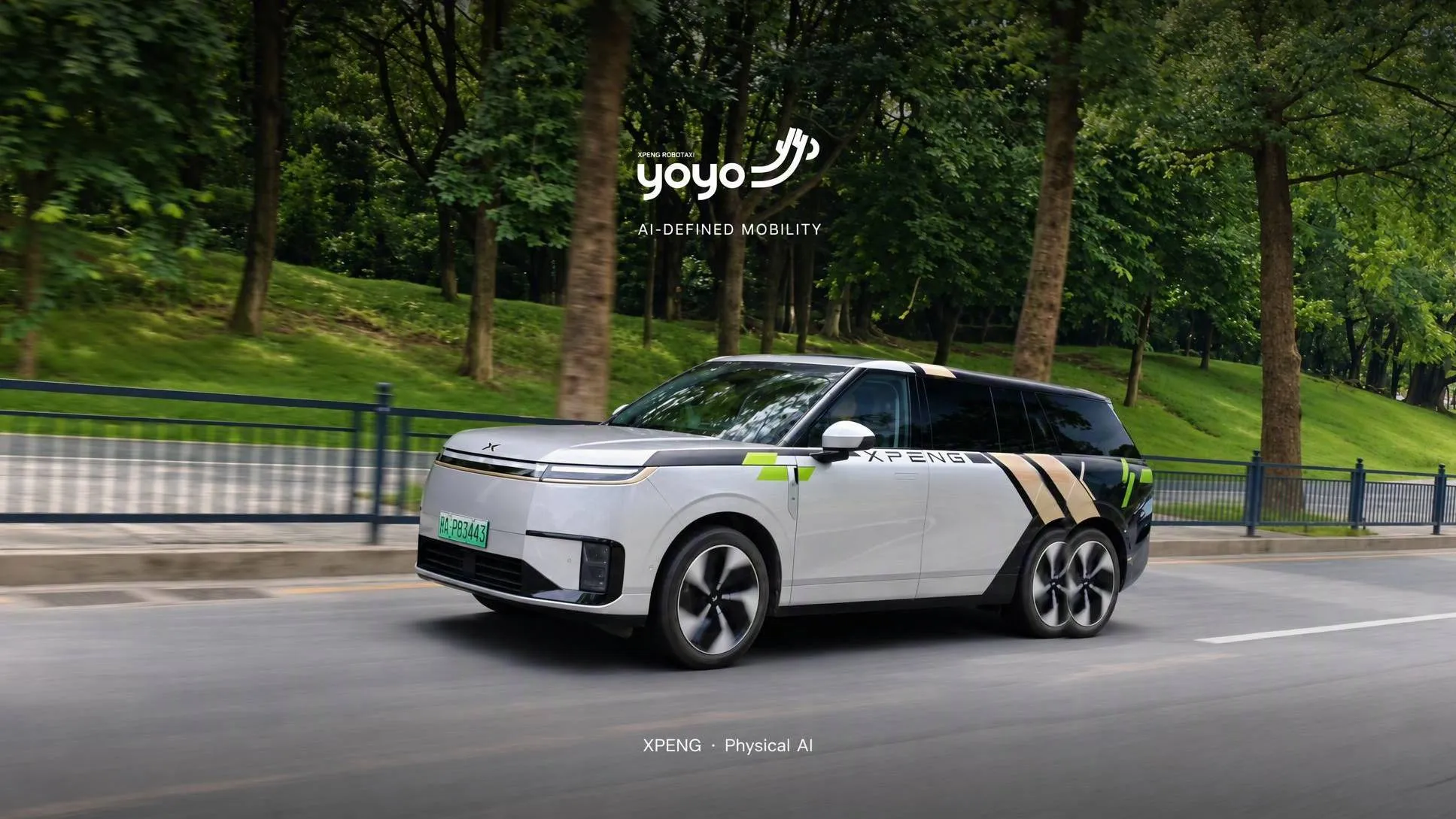
XPENG has named its robotaxi XPENG YOYO and opened invitation-code registration to the public in China, moving the vehicle, which runs on four in-house Turing AI chips rated at a combined 3,000 TOPS, from employee testing toward commercial operations. Alongside the registration launch this week, a dedicated XPENG YOYO page went live on XPENG’s official website. The company says the brand gives the program a defined commercial identity as it begins providing services to users and partners.
Highlights
- Public access: Online registration is open to the public in China through invitation codes, expanding rides beyond XPENG employees.
- Compute: Each vehicle carries four Turing AI chips rated at 3,000 TOPS, which XPENG claims is the highest in-vehicle compute in the world.
- Sensor approach: The system runs on XPENG’s VLA2.0 large model without HD maps or LiDAR.
- Driverless testing: In August, XPENG received Guangzhou’s remote testing qualification, allowing road tests with no safety operator in the driver’s seat.
From Production Line to Public Riders
XPENG describes the past several months as a progression from research and development through mass production and full-chain validation to public access:
- May 2026: The mass-produced robotaxi rolled off the production line in Guangzhou.
- July 2026: XPENG completed the full operating chain, from online ride-hailing to automated pickup and drop-off.
- August 2026: Guangzhou granted XPENG its remote testing qualification for intelligent connected vehicles, covering road tests without a safety operator in the driver’s seat on the city’s relevant Class I, II, and III test roads.
Before opening registration, XPENG ran paid internal testing at 1 yuan (about $0.15) per ride. The company says the low fare was intended mainly to validate the payment process and service workflow. Registration now extends the experience from employees to external users, which XPENG says will further validate product and operational capabilities ahead of its next phase of operations.
How Does XPENG’s Robotaxi Technology Differ?
XPENG describes its robotaxi as China’s first fully in-house-developed robotaxi to reach pre-loaded mass production. The company is extending the AI capabilities it built for its passenger vehicles into the robotaxi, using its Turing AI chips, VLA2.0 large model, and AI infrastructure to bridge L2 driver assistance and L4 autonomous driving.
Because the system does not rely on HD maps or LiDAR, XPENG says it can be deployed quickly across different cities and environments. The company characterizes this path as different from that of traditional L4 developers.
How Will XPENG Make Money From Robotaxis?
He Xiaopeng, chairman and CEO of XPENG, said the company positions its robotaxi business as a technology provider and ecosystem enabler rather than a fleet operator. Revenue would come from hardware sales, services, and commission sharing, with offline operations entrusted to global partners.
XPENG plans to supply a combined package of its vehicle platform, autonomous driving software, and AI capabilities. The company says the goal is to move the program from single-point validation toward scaled, global deployment. XPENG chose the English name XPENG YOYO for recognition in global markets ahead of future international expansion.
Cabin and Rider Experience
Riders can preset cabin temperature and activate a fragrance system through the online registration before boarding. Inside, the vehicle offers:
- Zero-gravity seats with massage functions
- A large entertainment screen with integrated content services
XPENG frames the robotaxi as a key part of its Physical AI strategy, which extends its AI from driver assistance in consumer vehicles to autonomous driving.