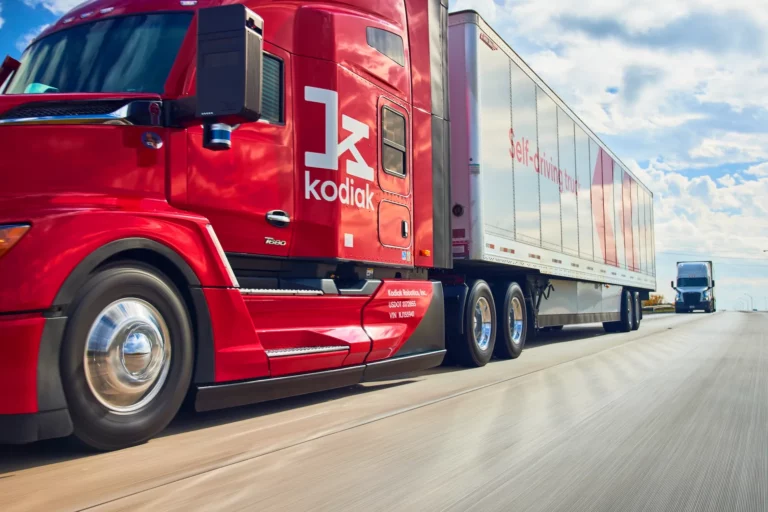


Kodiak AI has adopted two safety-engineering tools that, the company says, exposed a rare collision-risk scenario in minutes — a failure mode it estimates would otherwise take tens of thousands of miles of real-world driving to appear even once. The first is a Probabilistic Risk Assessment (PRA) model that estimates expected collision rates for the company’s autonomous trucks; the second is BreakPoint, an in-house AI tool that hunts for edge cases capable of causing collisions. Both methods borrow from aerospace and nuclear-energy safety practice, and Kodiak presents them as central to the safety case behind its driverless deployment.
Highlights
- The PRA decomposes each driving scenario into three factors — scenario exposure, collision likelihood, and severity — to estimate expected collision rates for events too rare to capture in road testing alone.
- The model is benchmarked against human-driver collision rates drawn from partnerships with transportation-research centers, with the goal of demonstrating better-than-human performance.
- BreakPoint injects time-varying errors into the autonomy system’s signals and adversarially steers the software toward simulated collisions to surface hidden failure modes.
- In one case, BreakPoint flagged a perception error involving stalled vehicles in Kodiak’s Industrial operating domain in minutes — a scenario the company estimates would take tens of thousands of real-world miles to surface once.
What Kodiak’s PRA Model Measures
Probabilistic risk assessment originated in safety-critical fields such as aerospace and nuclear energy, where systems must be shown safe across scenarios too rare to observe directly. Kodiak’s version combines Bayesian probability, systems engineering, reliability analysis, and statistical modeling into an inference engine that estimates expected collision rates of varying severity for the Kodiak Driver. The model also quantifies the uncertainty in its own assessment, indicating where the supporting evidence is strong and where it remains thin.
The PRA breaks each scenario into three factors:
- Scenario exposure — how often the vehicle encounters a given operating scenario.
- Collision likelihood — the probability of a collision once that scenario occurs.
- Collision severity — how serious the resulting collision would be.
Because the method is Bayesian, it updates as Kodiak gathers more data, and the absence of sufficient evidence counts against the system rather than being treated as neutral. The company says this pushes engineering effort toward under-explored scenarios instead of only fixing known faults.
Closing the Gap on Unknown Hazards
Traditional functional safety asks what happens when a component breaks. Kodiak frames the harder question as whether the system behaves safely when every component is working but conditions are unexpected — the domain addressed by the Safety of the Intended Functionality standard, ISO 21448 (SOTIF).
SOTIF sorts scenarios into four categories defined by whether they are known or unknown and safe or hazardous. Conventional testing handles the known cases well; the unresolved work lies in shrinking the set of unknown, hazardous scenarios. According to Kodiak, the PRA moves identified hazards from “known hazardous” toward “known not hazardous,” while BreakPoint searches the unknown space and pulls newly discovered hazards into the known column, where they can be quantified and addressed.
How Does BreakPoint Find Rare Failure Modes?
BreakPoint, built by Kodiak’s systems engineering and simulation teams, applies fault-injection testing to the autonomy stack. It introduces realistic, time-varying errors into the signals moving through the system and then steers its search adversarially, deliberately trying to drive the software into a simulated collision. When it succeeds, the tool estimates the risk of that failure mode and feeds the result back into the PRA.
This lets Kodiak probe the combinatorial range of scenario permutations without running an infeasible number of physical tests. The company reports that a BreakPoint analysis runs in minutes, can be executed by any of its autonomy software developers, and accelerates long-tail exploration by orders of magnitude. In one example, the tool identified a low-probability case in which the perception system could misjudge the velocity of stalled vehicles within Kodiak’s Industrial ODD — a failure mode the company estimates would have required tens of thousands of miles of real-world driving to appear even once.
A Continuous Safety Loop
Kodiak describes its contribution not as any single technique — adversarial simulation and probabilistic safety analysis both predate the company — but as the closed loop between the two tools. BreakPoint discovers failure modes and estimates their likelihood; the PRA incorporates those findings, identifies where evidence is weakest, and directs engineering attention toward the highest-impact unknowns. The “discover, quantify, prioritize, fix, and re-assess” cycle repeats continuously, with each pass narrowing the unknown-hazardous space and strengthening the case for driverless commercial operations.
Sign up for our weekly emails to stay up to date on the latest news!