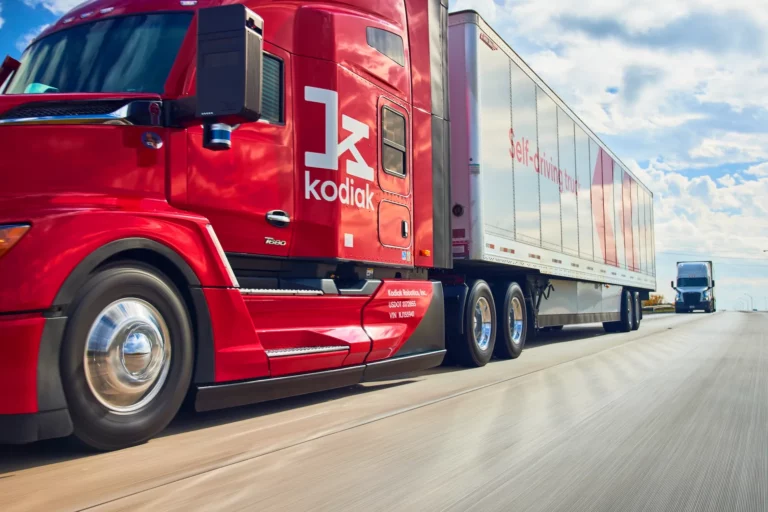


Torc Robotics has positioned AV 3.0, the framework powering its TorcDrive virtual driver software, as a transparent “glass box” architecture organized around three learned modules and built for SAE Level 4 long-haul trucking. The company introduced AV 3.0 in 2025 and recently published a breakdown of how the design evolved from earlier autonomous-driving generations. According to Torc, the approach is meant to pair the traceability of rule-based systems with the performance gains of end-to-end AI. The company also frames the explainer against public unfamiliarity with the technology, citing polling that 87% of Americans have never ridden in an autonomous vehicle or know anyone who has.
Highlights
- AV 3.0 organizes TorcDrive around three core modules — perception, prediction, and planning — supported by deterministic, rule-based guardrails.
- The platform targets SAE Level 4 autonomy on Class 8 trucks using Daimler Truck’s autonomous-ready 5.0 Freightliner Cascadia chassis.
- TorcDrive’s AI stack runs on an NVIDIA-powered embedded compute platform supplied by Flex.
- Torc cites polling indicating 87% of Americans have never ridden in an autonomous vehicle or know anyone who has.
From Rule-Based Logic to Learned Perception
Torc traces the lineage of its software to rule-based systems. In 2007, the company’s VictorTango team ran Odin, a modified 2005 Ford Escape hybrid, through roundabouts, intersections, and cross-traffic using pre-programmed if-then logic. Torc notes that such systems were highly interpretable, with each decision traceable to a specific rule or sensor input, which made failures straightforward to diagnose.
The arrival of deep learning in the mid-2010s brought what Torc calls AV 1.0, a hybrid approach combining learned perception with rule-based prediction and planning, drawing on cameras, lidar, radar, and high-definition maps. The company says these systems remained brittle because their downstream components were largely hand-engineered, leaving vehicles stymied by routine situations such as a misplaced construction cone or worn lane markings.
The Limits of the AV 2.0 ‘Black Box’
Torc describes the past five years as a leap to AV 2.0, end-to-end learned platforms that connect perception, prediction, planning, and control within a single trained model. The company likens these systems to large language models — capable, but opaque. In a fully integrated model, Torc says, it can be difficult to determine why a vehicle behaved a certain way or to correct one behavior without introducing regressions elsewhere, which raises development cost and slows iteration.
That tradeoff carries more weight in trucking, according to the company. Heavy trucks operate with longer stopping distances, reduced maneuverability, and a need for long-range perception, which Torc argues calls for combining the traceability of rule-based autonomy, the modularity of AV 1.0, and the performance of AV 2.0.
What Makes AV 3.0 a ‘Glass Box’?
Torc frames AV 3.0 as a “glass box” — an architecture whose major components can be inspected, validated, and improved individually, in contrast to a black-box model. TorcDrive’s stack is organized around three functional modules: perception, prediction, and planning. The company says this modular structure, learned end-to-end but bounded by deterministic guardrails and defined safety criteria, lets engineers examine intermediate outputs at each stage and target specific elements of the stack when changes are needed, validating at the module level before closed-loop testing.
Training and Validation in Simulation
Before reaching public roads, TorcDrive is trained through a large-scale data and simulation loop that Torc compares to a CDL driver-education program — except, the company says, the system is tested against rare and safety-critical scenarios at a scale no human driver would encounter in a career. Torc says its generative simulator is trained on real-world data captured by production-intent sensor suites on over-the-road trucks, generating scenes with cars, trucks, pedestrians, animals, varied road geometries, and edge cases that are difficult to collect repeatedly through road testing. The company notes that simulation supplements rather than replaces real-world validation.
A Production-Built Platform With Daimler
Torc became an independent subsidiary of Daimler Truck North America in 2019, a pairing it describes as the first strategic alliance between an autonomous-vehicle technology firm and a truck original-equipment manufacturer. Together the companies have built a Class 8 truck for SAE Level 4 operation — the level at which a vehicle handles the full driving task within a defined operating domain without a human taking over. The vehicle combines TorcDrive’s AI stack, an NVIDIA-powered embedded compute platform supplied by Flex, and Daimler’s autonomous-ready 5.0 Freightliner Cascadia, with sensors and safety-critical redundancies installed on the production line. Torc characterizes it as the first autonomous freight vehicle validated for highway operations on a production-ready, purpose-built platform rather than retrofitted after the fact.
Sign up for our weekly emails to stay up to date on the latest news!